Yes, real fur can shed, but only a little, and mostly in the first few wears. How much depends on the fur: long-haired rabbit sheds the most, fox may release a few loose hairs at first, and short, dense furs such as rex rabbit and mink shed very little.
So if you have just unwrapped a new fox collar and found a few hairs on your jumper, nothing is wrong. Here is what is normal for each type of fur, why it happens, and the small habits that keep it to a minimum.
Why does real fur shed?
Every fur piece is made by cutting and sewing pelts, or by cutting fur into strips and knitting it. That process leaves a few short, loose hairs caught in the fur. They work their way out in the first wears, which is why a new piece seems to shed more than one you have had for a month. On the fur collector forum The Fur Den, one member put it simply: “A little shedding is normal,” and another suggested it “could be loose hairs because of production process.”
After that, a small amount of shedding comes from friction: a bag strap rubbing the same spot, a seat belt, a scarf wound tightly over a collar. That part you can control.

Does fox fur shed?
A little, at first. Fox has long, silky guard hairs over a dense underfur, and those longer hairs are the ones you see on a dark coat in the first week. It usually settles after a few wears.
Fox is the fur on most of our pieces: the full ring on the Svalbard Hat, the 13 to 15 cm ring of the Frost Cuffs, the frame around the Fjord cardigan’s hood and the cuffs of the Tundra Wrap Jacket and Coat. A useful trick with any new fox piece is to take it outside and give it a few firm shakes before you wear it for the first time. One Fur Den member wrote that after taking a new fox outdoors and shaking it out “for a while, that made a big change.” More about how fox behaves on our fox fur page.
Does rabbit fur shed?
Yes, rabbit sheds more than the others. The French fur house Yves Salomon describes long-haired varieties as “particularly delicate and naturally prone to shedding.” It is the price of rabbit’s great quality: it is among the softest furs you can touch.
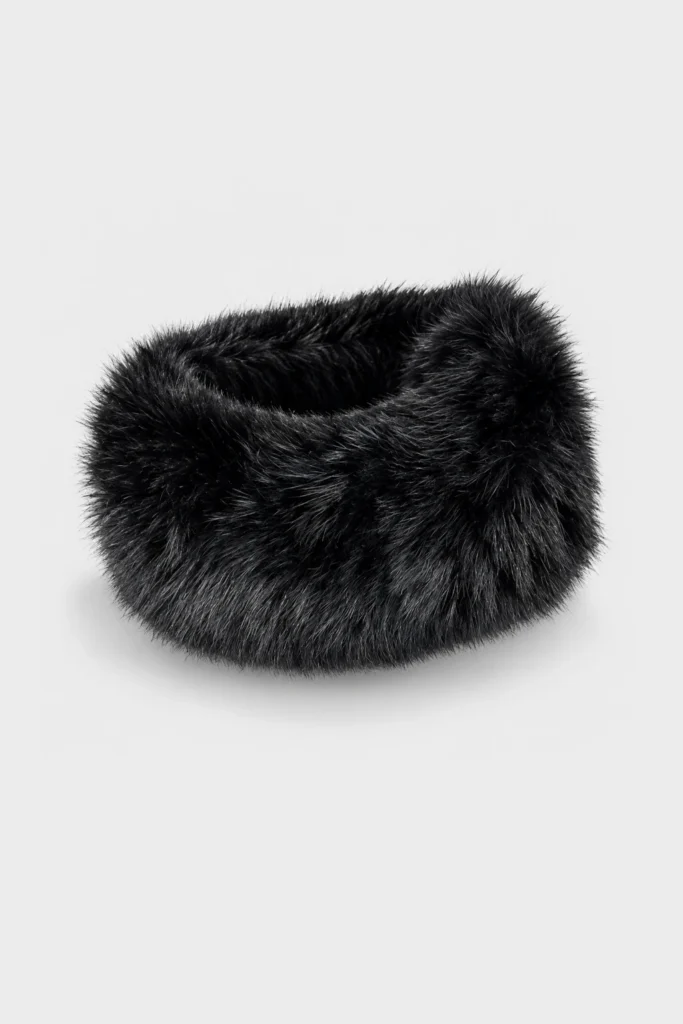
That is why rabbit is so often cut into strips and knitted, which holds it securely. Our Lumi Collar is made this way: hand-knitted strips of rabbit with a short pile, forming a snug tube from the shoulder to just under the chin. Expect a little loose fluff in the first wears. If you want to wear it over a black coat on day one, give it a good shake outside first. See our rabbit fur page for more.

Does rex rabbit shed?
Very little, and this is where rex rabbit earns its place. Rex is a rabbit breed whose guard hairs are the same length as its underfur. With no long hairs standing out of the surface, the fur is short, dense and even, with a feel close to velvet, and there is far less to work loose.

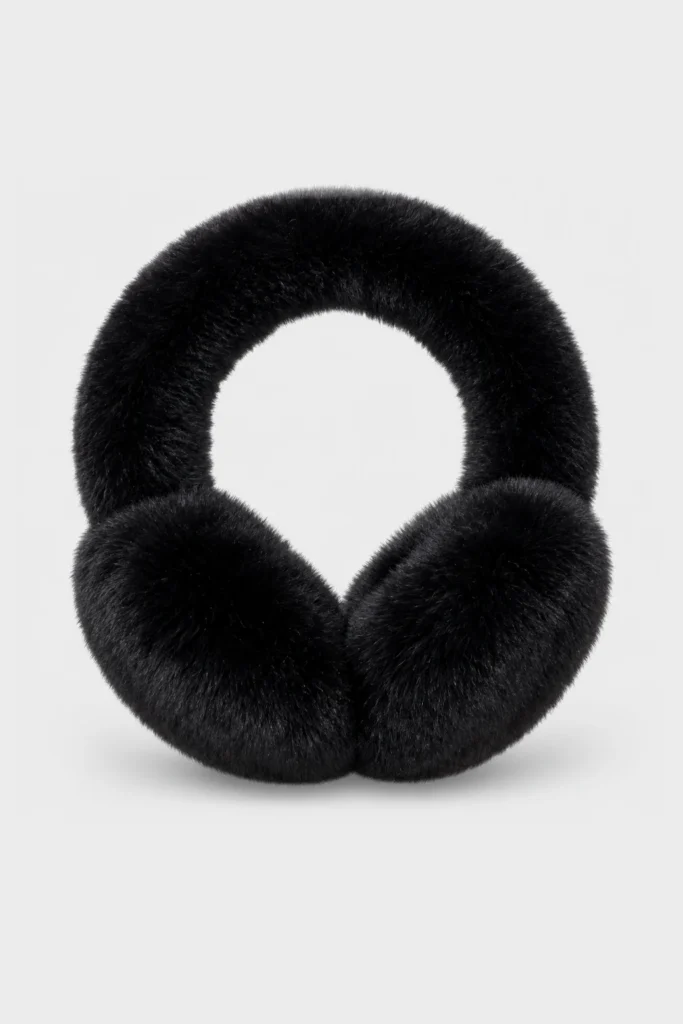
If shedding is the thing that has kept you away from fur, rex is where we would start. The piece we keep recommending for exactly this worry is the Halo Earmuffs: rex rabbit, so they feel like velvet rather than fluff, with the thick band and the cups made as one continuous piece of fur. They are rated 4.9 by 31 customers, and they sit happily against a black roll-neck. Our rex rabbit fur page explains the fur in more detail.
Does mink shed?
Hardly at all. Mink is short, dense and glossy, with a close pile that lies flat. On our pieces, mink appears only as the narrow trim, about 2 cm wide, down the placket of the Nordlys Down Jacket, and it is the least likely part of the jacket to leave anything on your clothes.
How do you stop real fur from shedding?
You can’t stop a fur from ever losing a hair, any more than you can stop your own hair. But you can keep it to almost nothing:
- Shake it outdoors before the first wear, and again after the first two or three. This releases the loose hairs from production all at once, outside rather than on your coat.
- Don’t brush it hard. A stiff brush pulls hairs out. If anything, use your fingers to fluff it gently.
- Watch the bag strap. The Fur Institute of Canada warns that “shoulder bag straps can break fur hairs and create bald patches.” Carry your bag in your hand or on the other side from the collar.
- Keep products off it. The Fur Institute says perfume and hairspray can dry the fur and make it sticky. Spray first, then put the fur on.
- Store it well. Cool, dark and airy, never in plastic, and never on a radiator. Dry fur breaks more easily than fur that is cared for.
- Dry it naturally if it gets wet. No hair dryer, no brushing until fully dry. More on this in can you wear fur in the rain.
What should you wear with fur that might shed?
In the first week, think about what is underneath. Loose hairs show most on dark, smooth, tightly woven fabrics such as black wool coats and fine black knits. They show least on textured or tonal fabrics.
A few easy pairings while a new piece settles:
- Match the fur to the coat. An ivory fur collar on a camel or ivory coat, a black fox hat with a black coat. Any stray hair simply disappears.
- Choose texture. Chunky knits, bouclé and tweed hide the odd hair; flat black gabardine shows everything.
- Keep a lint roller by the door for the first fortnight, then you will rarely need it.
When is shedding not normal?
A few hairs is normal. These are not:
- Clumps of hair coming away in your hand.
- Bald patches, or the leather side showing through.
- Heavy shedding that does not ease after many wears.
On a new piece, any of these is a reason to contact the seller. Arctic Blanc pieces come with 14 days to return, and you can write to [email protected]. On an older piece, heavy shedding often means the fur has dried out from heat or poor storage, and a furrier is the person to see.
The short version
Real fur sheds a little at first and then settles. Rabbit sheds most, fox a little, rex rabbit and mink hardly at all. Shake it outdoors, skip the hard brush and keep bags and perfume off it. For the full routine, read our guide on how to care for real fur.